
NEWS: Conran and Partners joins DLR Group
We are pleased to announce that Conran and Partners has joined DLR Group, the global integrated design firm.
Read the full announcement to learn what this means for our studio, our clients and our work.
Authored by Tim Bowder-Ridger, Partner and Principal
Whilst the majority of our practice’s adaptive reuse projects in the UK have been focussed on listed heritage assets, we have been long convinced that this approach is equally valid for non-listed buildings, from both social and environmental perspectives. Encouragingly, the industry here now broadly shares this perspective with an increasing bias towards it being the first option to be considered.
London is a compelling demonstration of why reuse works. Its richness as a city comes not from constantly building “new”, but from an embedded culture of reinvention – from building-scale transformations to district-wide regeneration such as King’s Cross. This long tradition of upgrading rather than replacing has the potential of becoming one of the city’s greatest exports.
Over the years an expanding proportion of our work has taken place outside of the UK, with Asia taking the largest slice of the cake. In these markets we have long banged the drum of adaptive reuse as the first port of call, but with limited success in markets where ‘new’ is best. However, that is beginning to change, as manifested with our recent Park Hyatt project in Changsha, China.
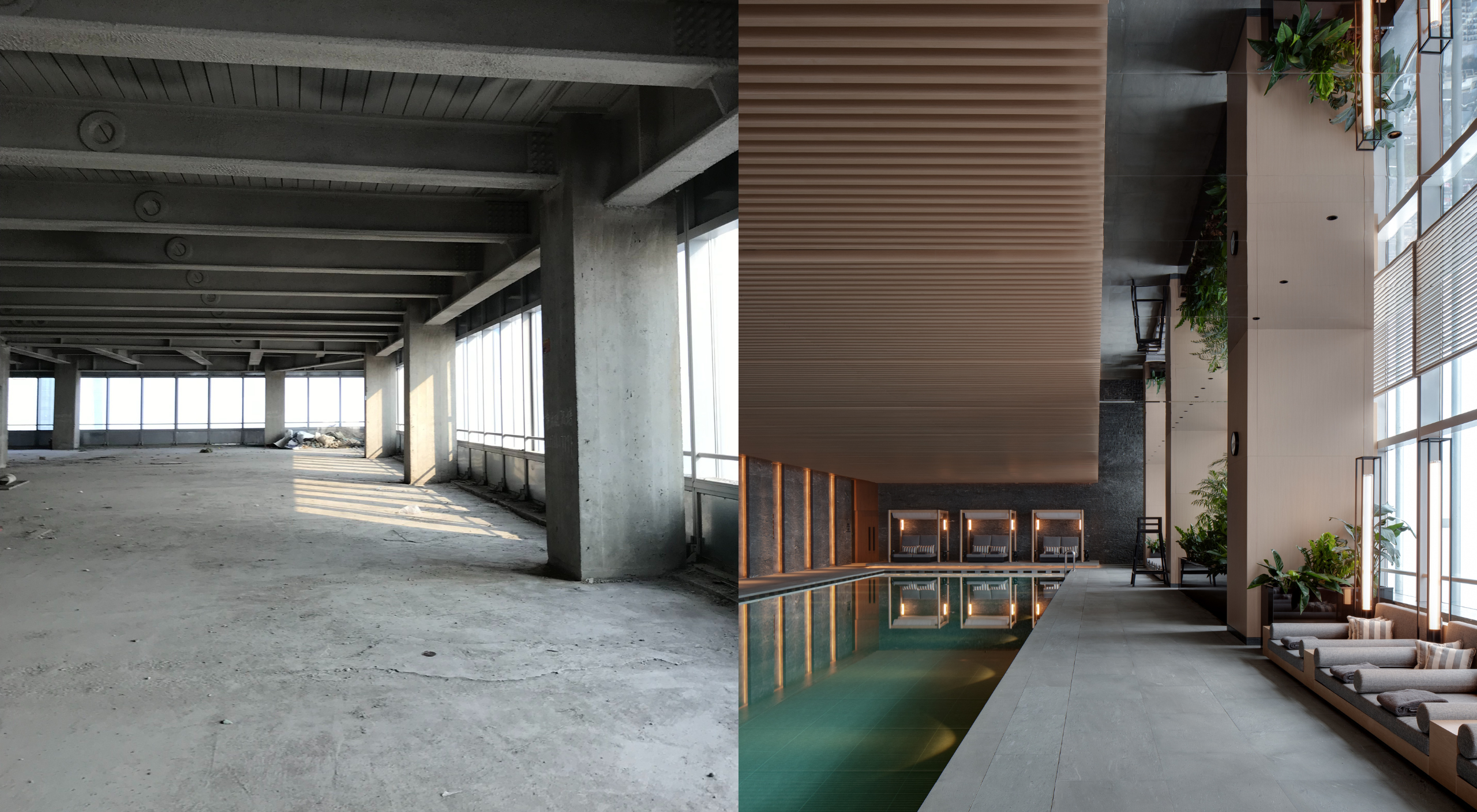
A project that took a high-rise office building and repurposed it into hotels in the heart of the city. It also highlights what I think of as the adaptive reuse paradox: the regions that need it the most, with extreme climates, rapid growth and vast stocks of young but underperforming buildings, are often the ones most culturally aligned with demolition and new-build. But things are slowly changing.
Across China, cities are now reimagining redundant industrial estates and mid-rise commercial zones as innovation districts and mixed-use quarters. What started as isolated experiments is becoming a strategic response to land scarcity, carbon targets and evolving economic priorities.
In the meantime, we have begun to work in the Kingdom of Saudi Arabia. Few countries in the world could possibly represent the drive for the ‘new’ more powerfully, yet there is a growing drive to protect and repurpose important heritage assets – something we hope to contribute directly to. Major national programmes such as Historic Jeddah and Diriyah demonstrate how reuse is being positioned as a cultural anchor amid rapid transformation.
On a recent journey through Riyadh on the brand-new metro, the contrast between the low-rise urban grain and isolated new tower clusters was striking. Many of these neighbourhoods, products of building booms from the 1950s onwards, have mixed architectural quality but enormous adaptive potential.
As the city grows to serve a young and expanding population, continually building outwards or upwards will only intensify climatic challenges.
Instead, these neighbourhoods could be reinvented as denser, mixed-use districts that alleviate congestion and reduce car dependency. Rather than flattening entire city blocks, only to replace them with more carbon-heavy concrete, we should bring them up to modern needs and performance standards, and thereby creating a virtuous circle of minimising destructive waste, limiting carbon and reinforcing neighbourhoods – while still embracing the ‘new’. Riyadh has an opportunity to upgrade what it already has. Much of its mid-century building stock is low-rise, concrete-framed and probably relatively straightforward to reskin, reconfigure and enhance.
Elsewhere in the region, adaptive reuse is already gaining traction. Heriot-Watt University in Abu Dhabi by BDP has shown that repurposing redundant industrial buildings can reduce disruption and embodied carbon simultaneously. This suggests that reuse is not only a heritage or hospitality strategy but a viable model for institutional, educational and civic assets.
The real question is no longer whether the world is ready for adaptive reuse. What is clear from our experience in Asia and the Middle East is that these regions hold enormous potential.
Their building stock and rapid urban growth create a unique opportunity to lead the adaptive reuse revolution. The next decade will not be defined by demolition and expansion, but by reinvention – and the cities that thrive will be the ones capable of transforming what they already have.
